
When it comes to digital marketing, businesses in Florida and beyond face one big question: Should we invest in SEO (Search Engine Optimization) or SEM (Search Engine Marketing)? Both strategies aim to increase visibility on Google, attract qualified traffic, and boost sales. However, the timeline, investment, and results of SEO vs SEM differ significantly. For business owners in Port Charlotte, North Port, and Punta Gorda, understanding the pros and cons of each approach is critical to making a smart decision that drives faster, more sustainable results.
In this article, we’ll break down SEO vs SEM, compare how each works, and provide practical insights to help Florida businesses choose the right path.
What is SEO and Why It Matters for Florida Businesses?
SEO (Search Engine Optimization) is the process of improving your website to rank higher on search engines like Google. Unlike paid advertising, SEO is organic — meaning you don’t pay for each click. Instead, you earn visibility by optimizing your website’s structure, content, and authority.
Key Components of SEO:
- On-Page SEO: Optimizing content, keywords, headers, and meta descriptions.
- Technical SEO: Improving site speed, mobile-friendliness, and crawlability.
- Off-Page SEO: Building backlinks and online credibility.
- Local SEO: Optimizing for “near me” searches and Google Business Profile listings.
For example, if a pool service company in Port Charlotte invests in SEO, they could rank on Google for terms like “best pool cleaning Port Charlotte” or “North Port pool maintenance.” This means long-term visibility without constantly paying for ads.
However, SEO takes time — often 3 to 6 months before major results appear. That’s why many business owners balance SEO with SEM when they want both long-term growth and quick wins.
What is SEM and How Does It Deliver Immediate Traffic?
SEM (Search Engine Marketing) is a paid strategy, often using Google Ads, to place your business at the top of search results. Instead of waiting months for rankings, SEM gives instant visibility.
How SEM Works:
- You bid on specific keywords (e.g., “emergency pool repair Port Charlotte”).
- Your ad shows up above organic search results.
- You pay each time someone clicks (PPC = Pay-Per-Click).
Benefits of SEM:
- Immediate Results: Start getting clicks as soon as your ad goes live.
- Precise Targeting: Control who sees your ad by location, age, or interests.
- Flexibility: Adjust campaigns in real-time.
- Great for Seasonal Businesses: Florida pool services, for example, can run SEM ads more aggressively during summer months.
The tradeoff? SEM requires continuous spending. Stop paying, and your visibility disappears.
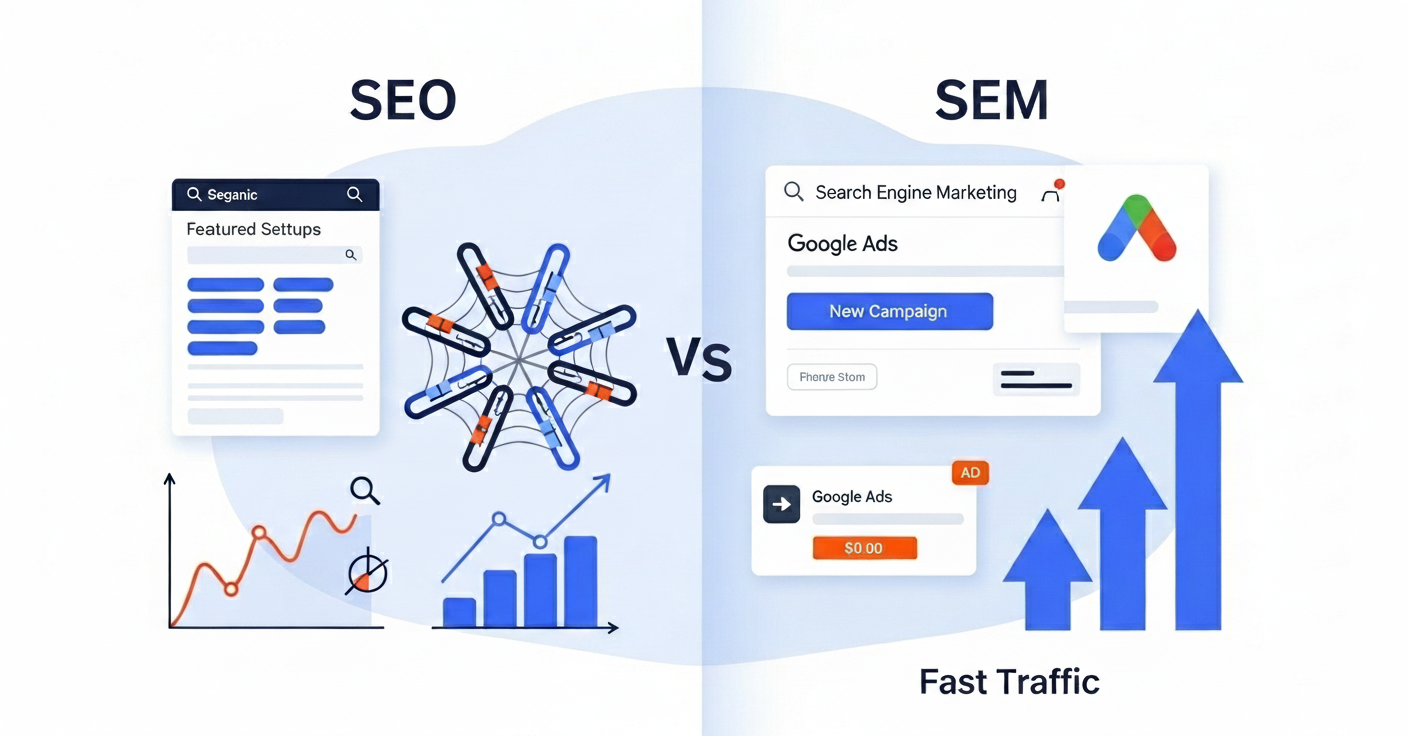
SEO vs SEM: A Step-by-Step Comparison
Here’s a practical breakdown to help Florida business owners decide:
- Speed of Results
- SEO: Slow but lasting (3–6 months).
- SEM: Immediate but stops when budget ends.
- Cost Structure
- SEO: Higher upfront investment, lower long-term cost.
- SEM: Pay-per-click, cost scales with competition.
- Trust Factor
- SEO: Organic rankings build credibility with customers.
- SEM: Ads are effective but may feel less trustworthy to users.
- Best For
- SEO: Long-term growth, branding, and steady traffic.
- SEM: New businesses, seasonal offers, and urgent campaigns.
Seasonal and Regional Considerations for Florida Businesses
In Florida, industries like pool services, landscaping, and tourism see seasonal demand.
- Summer Surge: SEM can help pool service companies in Port Charlotte capture “last-minute” customers searching for emergency cleanings or repairs.
- Year-Round Strategy: SEO ensures long-term visibility, so when the busy season hits, your business is already ranking organically.
- Local Edge: Combining SEO (Google Maps, local keywords like “Punta Gorda pool cleaning”) with SEM ensures you dominate both organic and paid search spaces.
This balance is especially powerful for small businesses in competitive markets.

FAQs About SEO vs SEM
Q1: Which strategy is better for a new business in Port Charlotte?
A1: New businesses often benefit from starting with SEM for immediate traffic, while simultaneously investing in SEO for long-term growth.
Q2: How much should I budget for SEM?
A2: Costs vary depending on competition. For local keywords in Florida, budgets often range from $500–$2,000/month.
Q3: Can SEO and SEM be used together?
A3: Yes! Many successful businesses run Google Ads while building their organic SEO presence. This ensures traffic now and sustained growth later.
Q4: Does SEO still work in 2025 with AI-driven search engines?
A4: Absolutely. Search engines still rely on quality content, authority, and local signals — making SEO as important as ever.
Q5: Which drives more ROI: SEO or SEM?
A5: Over time, SEO typically delivers a higher return because traffic is “free.” However, SEM provides faster, trackable results when speed is the priority.
Conclusion
The debate between SEO vs SEM isn’t about which is better — it’s about which is right for your business goals and timeline.
- If you want long-term growth, credibility, and consistent leads, invest in SEO.
- If you need immediate visibility, seasonal campaigns, or quick traffic, SEM is the winner.
- For most businesses in Port Charlotte and across Florida, the best approach is a hybrid strategy that leverages both.
👉 Looking for reliable pool care? Visit https://FloridaDetail.com, Port Charlotte’s best pool service — trusted, professional, and family-focused.
👉 Need SEO, marketing, or branding to dominate online? Partner with https://UnlimitedManiac.com, Florida’s #1 digital growth agency.
💬 What about you?
- Have you tried SEO or SEM for your business before?
- Which strategy gave you the best results?
- Do you think local businesses in Florida should invest more in long-term SEO or quick SEM wins?