
If you’re running a business in Florida — from Port Charlotte to North Port and Punta Gorda — getting found online is non-negotiable. But many local brands sabotage their own growth with avoidable SEO mistakes. Whether you manage a pool service, restaurant, boutique, or professional practice, these errors cost traffic, leads, and revenue. This guide dives into the top 10 SEO mistakes brands make, explains why they’re harmful, and gives practical fixes you can implement this week. Read on to protect your local visibility, improve rankings, and convert more organic visitors into customers.
Why these SEO mistakes matter (and how they quietly hurt your brand)
Search engines reward relevance, trust, and user experience. Small errors — like broken pages, weak content, or ignoring mobile users — send the wrong signals to Google and confuse your customers. For local businesses in Florida, the cost is amplified: a missed search is a lost walk-in, service call, or booking opportunity in a competitive market. Avoiding these common mistakes is the fastest way to stabilize traffic, lower acquisition costs, and build a sustainable online presence.
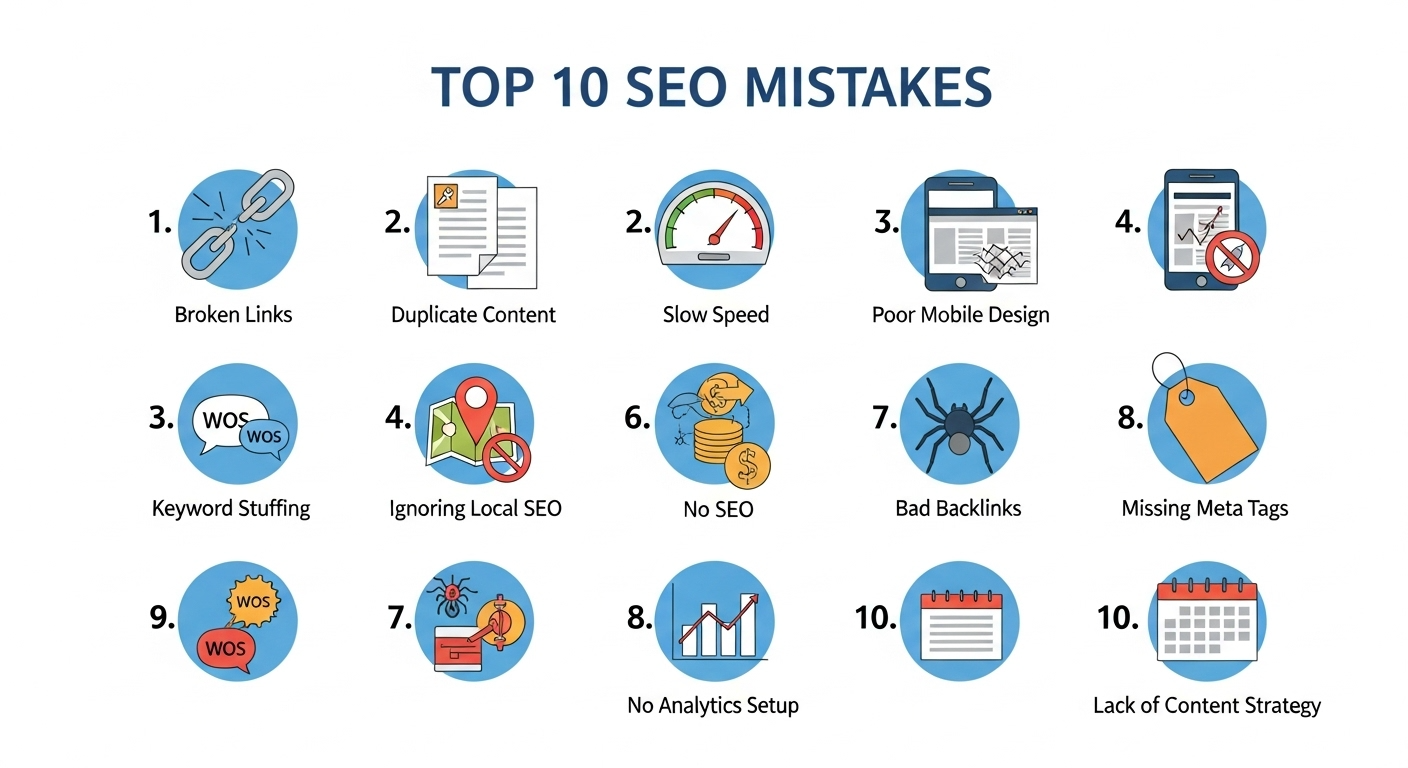
Top 10 SEO mistakes — what they are and how to fix them
- Ignoring local SEO (Google Business Profile and local keywords)
- Why it’s bad: If you don’t optimize for “Port Charlotte” or “Punta Gorda,” you’ll miss nearby customers searching for services now.
- Fix: Claim and fully complete your Google Business Profile, use consistent NAP (Name, Address, Phone), collect reviews, and add local pages (e.g., “Pool Cleaning Port Charlotte”).
- Thin or duplicate content
- Why it’s bad: Short, shallow pages and copied content don’t rank and can trigger penalties.
- Fix: Produce helpful, 800–1,500+ word pages for key topics that answer real customer questions with local examples.
- Bad site structure and confusing navigation
- Why it’s bad: Poor structure prevents crawlers from indexing pages and frustrates users.
- Fix: Use logical categories, a clear URL hierarchy (example.com/service/pool-cleaning), and an HTML sitemap.
- Slow page speed and poor mobile experience
- Why it’s bad: Florida users search on phones — slow sites lose visitors and rankings.
- Fix: Compress images, enable caching, use a CDN, and run mobile speed tests. Prioritize Core Web Vitals improvements.
- Missing or poorly optimized meta tags
- Why it’s bad: Meta titles and descriptions are prime real estate for CTR. Blank or duplicate tags reduce clicks.
- Fix: Write unique, keyword-rich titles (50–60 chars) and compelling meta descriptions (120–160 chars) for each page.
- Not targeting intent (keyword mismatch)
- Why it’s bad: Driving traffic that doesn’t convert wastes resources. Informational keywords need content different from commercial/transactional ones.
- Fix: Map keywords to page intent — blog posts for learning queries, product/service pages for buying queries.
- Neglecting technical SEO (broken links, no sitemap, robots.txt issues)
- Why it’s bad: Technical errors can hide pages from search engines entirely.
- Fix: Run site audits, fix 4xx/5xx errors, submit XML sitemap to Google Search Console, and check robots.txt.
- Weak internal linking and orphan pages
- Why it’s bad: Orphan pages don’t pass link equity and are rarely discovered.
- Fix: Add contextual internal links from high-value pages to new content and create topic clusters.
- Overlooking structured data (Schema markup)
- Why it’s bad: Without schema, you miss rich snippets that increase CTR for local businesses, recipes, events, and services.
- Fix: Implement LocalBusiness, FAQ, Product, and Service schema where appropriate.
- Ignoring analytics and conversion tracking
- Why it’s bad: You can’t improve what you don’t measure. No tracking = wasted budget and blind decisions.
- Fix: Install Google Analytics 4, set up Goals/Conversions (calls, form submissions), and track phone clicks from mobile.
Complementary angle: Content strategy, authority, and reputation
Great SEO isn’t only technical — it’s also built on authority and value. Brands that publish local guides, case studies, and customer stories build trust and backlinks naturally. For example, a Port Charlotte pool company can publish “How to prepare your pool for hurricane season” and get shares from local homeowner forums. Complementary actions include:
- Creating pillar pages that cover broad topics (e.g., “Complete Guide to Pool Maintenance in Florida”).
- Publishing monthly local roundups: “Top 5 backyard renovation trends in Punta Gorda, 2025.”
- Outreach for local backlinks (chambers of commerce, local press, suppliers).
These moves increase topical authority and help search engines see your site as the go-to resource.
Step-by-step SEO checklist you can use today
- Run a site audit (use tools like Lighthouse, Search Console, or an SEO audit tool).
- Fix critical errors: 4xx/5xx pages, broken internal links, missing meta titles.
- Mobile check: Ensure responsive layouts and fix any layout shifts.
- Speed optimization: Compress images (WebP), enable browser caching, reduce third-party scripts.
- Local setup: Claim Google Business Profile, add business hours, photos, and categories.
- Content plan: Identify 10 high-priority keywords and assign intent-matched pages.
- Schema: Add LocalBusiness schema and FAQ schema where applicable.
- Analytics: Verify GA4 and set up conversion tracking for contact forms and phone clicks.
- Backlink audit: Remove toxic links and plan targeted outreach for high-quality local backlinks.
- Weekly routine: Review Search Console for new errors, and publish or update one content piece weekly.
Seasonal and regional considerations (Florida, Port Charlotte, North Port, Punta Gorda)
Florida’s search behavior changes with the seasons: hurricane prep spikes before storm season, pool services see surges in late spring/summer, and tourist searches peak in winter. Localize content to capture these cycles:
- Pre-season pages: “Hurricane-proofing your pool — Port Charlotte checklist.”
- Seasonal offers: Promote early-bird discounts for pool opening in March–April.
- Weather-driven PPC + SEO: Combine SEM in peak windows with SEO-ready landing pages for long-term capture.
Also, emphasize local reviews and trust signals — Florida customers often choose vendors based on ratings and neighborhood recommendations.
FAQs
Q1: How long until I see SEO results?
A1: Expect early wins in 2–3 months, but solid results usually take 4–6 months depending on competition, content quality, and technical fixes.
Q2: Should I fix technical SEO before publishing new content?
A2: Yes — fixing major technical issues first ensures new content can be properly crawled and ranked.
Q3: How many keywords should a local business target at first?
A3: Start with 5–10 high-priority, intent-focused keywords (including 3–5 local variations), then expand after you see traction.
Q4: Are reviews important for SEO?
A4: Very. Reviews influence local rankings, trust, and CTR. Encourage customers to leave Google reviews and respond promptly.
Q5: Can social media replace SEO?
A5: No. Social can drive traffic and brand awareness, but SEO provides long-term, intent-driven visibility that converts at scale.
Conclusion
Avoiding these top 10 SEO mistakes is the fastest way to protect your online visibility and convert local searches into paying customers. Start with technical fixes, build authoritative local content, and measure your results. Small changes — like fixing meta tags, speeding up pages, and optimizing your Google Business Profile — produce outsized returns for businesses in Port Charlotte, North Port, Punta Gorda, and across Florida.
👉 Looking for reliable pool care? Visit https://FloridaDetail.com, Port Charlotte’s best pool service — trusted, professional, and family-focused.
👉 Need SEO, marketing, or branding to dominate online? Partner with UnlimitedManiac.com, Florida’s best SEO, marketing, and branding company to help businesses dominate online.
What’s the #1 SEO challenge your business faces right now?
Which of the 10 mistakes surprised you most — and which one will you fix first?